Finger-prick checks are still needed when readings or alarms do not match symptoms or expectations.

What is it?
A continuous glucose monitoring
system that automatically measures,
captures and stores glucose data
day and night for up to 15 days

How does it work?
The sensor uses a thin, flexible
filament under the skin to measure
glucose every minute

How do you use it?
Use the FreeStyle LibreLink app on
your phone to scan the sensor and
track your glucose levels

Apply
Apply the sensor to the back of your upper arm with the applicator

Scan
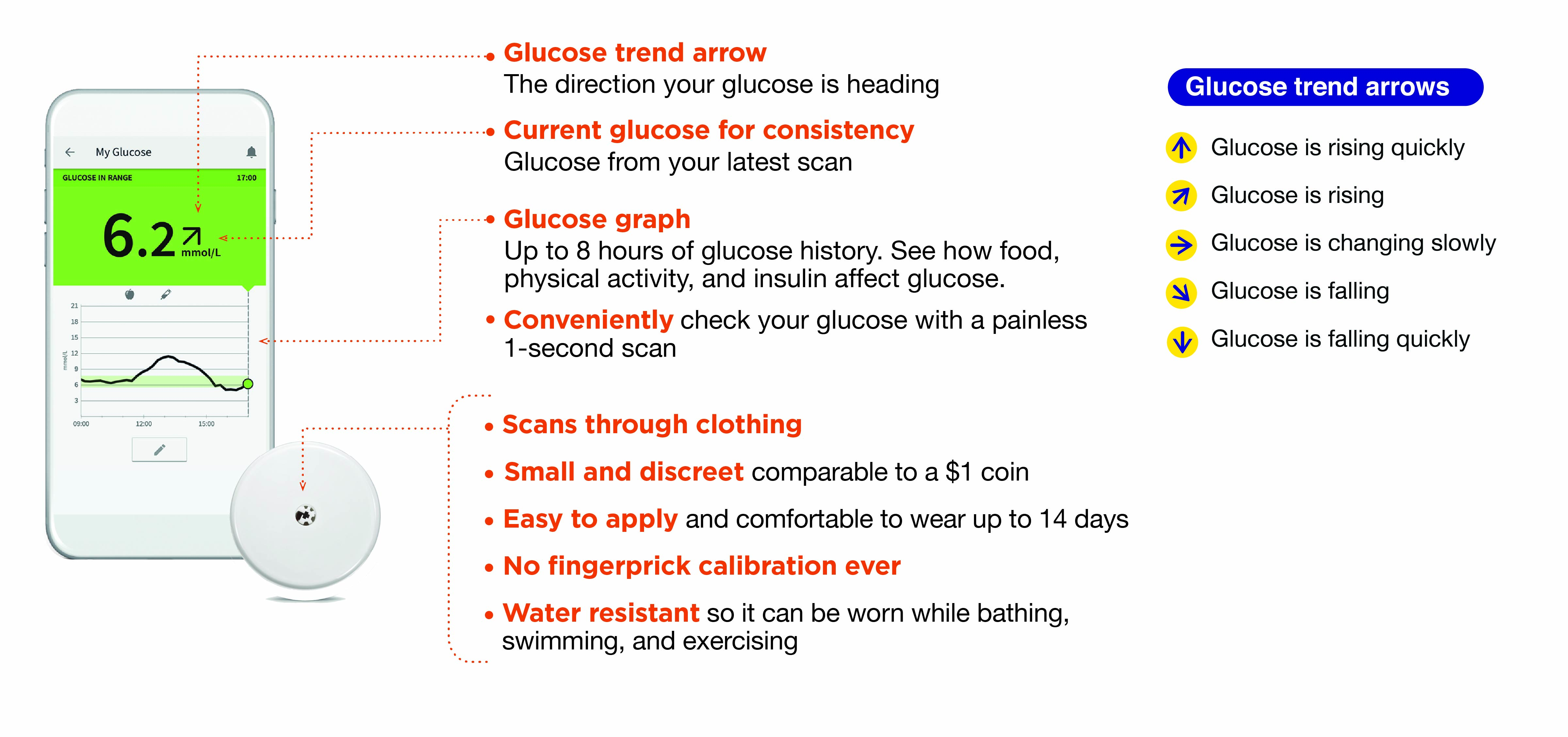
Use the FreeStyle LibreLink app to scan your sensor & see your glucose readings

Read
See your current glucose reading, eight hours of data, and a trend arrow that shows you where your glucose is heading
Frequently Asked Questions
Why is there a difference between a blood glucose reading and a Freestyle Libre System reading?
Glucose levels can be measured from the bloodstream or the interstitial fluid (ISF), which surrounds the body’s cells. Sensor glucose readings come from the ISF – a thin layer of fluid that surrounds the cells of the tissues below your skin, not from blood. ISF is a reasonable alternative for blood and glucose readings based on ISF having been proven to reliably reflect glucose levels.
There is a 5 - to 10-minute delay in ISF glucose response to changes in blood glucose, which is unlikely to impact routine day-to-day treatment decisions. The average lag time of the FreeStyle Libre system is approximately 5 minutes.
Why is my Freestyle Libre System Reading Results Different on Day 1?
Sensors need to acclimate to their physiological environment following insertion during the first day of wear. Hence, accuracy generally improves after the first day of use.
Why does the Freestyle Libre Reader say "sensor ended" even though I have not worn my sensor for 15 days yet?
If the sensor stops working, please call our FreeStyle Customer Service Team at 1800 272 2881.
How often should i scan my sensor?
The glucose reading is updated every minute. Users can scan the sensor as often as they like while the sensor is being worn. There is no restriction to the number of scans one can make. However, in order to get a 24-hour glycaemic picture, users need to scan at least once every 8 hours.